Sunday, March 17, 2013

MONEY BACK GUARANTEE?


So me and Diane Ravitch were chillin’ today in Baton Rouge discussing some education stuff. . . .
Posted on March 14, 2013
5

So me and Diane Ravitch we chillin’ today in Baton Rouge discussing some education stuff. . . .  :)
I figured I’d start off my post that way since it sounds much cooler than Diane came to town and gave an awesome speech at a luncheon (and Chas Roemer was also there as the comic relief) and I was fawning over her like an obsessed anti-reform education groupie (do they have those?) But I digress.
Diane made a very excellent speech summarizing all the ways Louisiana’s education system is dead set and hell-bent on a road to ruin. The counterpoint or rebuttal was made by current BESE (the state board of education) President Chas Roemer. I would like to to say that Chas’s points were simply less eloquent and and passably adequate, but they were actually pretty insulting for most parents - about 98% of them to be exact.  I had every intention of listening politely, until he responded to a question about the low voucher (private school) participation percentage this way.
“Rather than question why the participation in the voucher program is only 2%, I would question why only 2% of parents care about their student’s educations.”
This of course was after making much ado about providing “choice” to parents, but I think it reveals his true feelings. If you don’t send your kids to a creationist teaching, revisionist history teaching, private school, then you are a bad parent and don’t care about your children. Until this point I was simply happy to be at the Drusilla Seafood gathering, where they served chicken. (It was decent chicken, but really, if you invite people from out of state to a restaurant with “seafood” in the name you’d think there would be some?) Chas Roemer concluded his speech by describing something he said he likes to call his “money back guarantee.”
“If charters don’t perform well, they get shut down.” – ( and new charters perpetually open in their place (until one succeeds I presume?)
Some folks at my table shouted out, “when do we get our money back?”
When indeed? I suppose this is the “exceptionalism” that one can expect from someone who is a product of the private school system, like Chas.
Suffice it to say I was not about to let these statements go without redress, but alas, the person right in front of me, the esteemed professor and researcher Barbara Ferguson, was the last to get a volley off, and I was left with my question unasked.
Whenever I see her from now on I will say “Ferguson!” under my breath as an homage to Jerry Seinfeld and his arch nemesis Newman.
So I present to you my readers, my question(s).
Maybe one of you can forward it to Chas to see if he has a response?
Hi. My name is [redacted], and unlike Chas, I was not surrounded by politics and career politicians my whole life. I am a parent of public school students in Baton Rouge that attend [redacted] Elementary. My wife is on her second year of PTA president for the [redacted] Ducks, and we volunteer for many of the school functions and field trips as chaperones. For years I’ve volunteered as a mentor to work with children through the Big Buddy program in Baton Rouge. I am a product of the Baton Rouge Public school system and my wife was a teacher in this schools system for several years.
I would like to first say that as a parent I am deeply offended by the comment Chas made in response to the low participation rate in the voucher school program “he wonders why only the 2% of parents that applied for private school vouchers care about the education of their students.” I want my kids to go to public schools because I care about them, and because I don’t want them artificially sheltered from their peers in racial and social class silos like Chas’s kids. That is a choice he has made, but by defunding and overburdening public schools Chas is eliminating “my choice,” to have my kids attend a vibrant, robust, communal public education system.
Chas’s statements reveal his true feelings, he doesn’t believe public schools are a valid “choice” and so he is trying to eliminate them so I am forced into conforming to his choice. Reform is about convincing you that you made the wrong choices and guilting you into choosing something else that is unproven and often worse.
Chas, charter schools and voucher/private schools are not subject to the same oversight and reporting that public schools are. You claim your objective is to offer parents choices, but how can parents reasonably be expected to make informed choices when you don’t report the same statistics for them as you do for the public schools you denigrate? The department website was recently revamped to remove most historical data and the department routinely refuses to provide data – to researchers it deems unfriendly. I know this because I am a witness in a case against the Louisiana department of education involving the sharing of basic student data to a researcher in Orleans. That data already exists and has been given to other “friendly” researchers! I know this for a fact, because I am a former Louisiana Department of Education employee and I worked in the data management department and I actually prepared the data being requested – but for other groups!
We were instructed by John White and Erin Bendilly (a Jindal appointee assigned to ram through the charters at LDOE) to leave charters alone when their data was incomplete or obviously wrong, and many reporting requirements were not “requirements” for charter operators and virtual schools (like attendance). Schools in New Orleans that are “taken over” by the state are not assigned SPS (School Performance Scores) for 2 years after they are handed off to another operator.
How can parents make informed, real “choices” without data? Charter schools are like random TV dinners, but without any nutritional information. Could you plan a nutritional healthy family meal without any information on calories, preservatives, vitamins and minerals or sodium content? How would you choose between all the offerings: based on the look of the package, the taste? That is what charter schools and voucher schools are, unlabeled, mislabeled, or attractively labeled TV dinners that you expect us to feed our family for 2 years and “Believe” that they are good. Sure, we might be able to figure out after a while what is offered is crap, after our kids start getting fat or having heart attacks, but is that a fair choice to make, or to force us, as parents, to make? The free market has shown that Doritos and donuts are more popular that bananas and yogurt, but that doesn’t make them better, and providing those choices does nothing for our children but put them at risk for obesity and diabetes. Charter schools and voucher schools are the junk food of the education system, but without the proper labeling.
Fresh charter school choices, just heat, Believe and serve!
If you truly believe that charter schools and voucher schools are “better” choices, and not just additional ones, why does BESE and John White not encourage proper reporting of data and free access of data to researchers that request it? Surely if we are concerned about parents and students making informed choices, this is common sense?
As a parent, I find it hard to believe even you and your political sponsors believe this is about students and parents when you fight proper and timely disclosure of data that could be used to properly evaluate these “choices” and misrepresent failure (like the perpetual closing and rebranding of charter schools) as success.
And by the way, how much money has the state gotten back on your “Money Back Guarantee” for failed charters? When people sell you a shoddy product and they get to keep the money and walk away and open up shop somehwere else, that is not a money back guarantee, that is just a robbery (to which you are an accessory), and sadly only half the story.  How have you reclaimed the lost educational years for the students you allowed to be experimented on, only to find the experiment was a failure?

Wednesday, February 13, 2013

LATEST STORY ABOUT MUSKEGON HEIGHTS ACADEMY -- UNCERTIFIED TEACHERS


Investigation uncovers non-certified teachers at Muskegon Heights new charter school

Teachers in Michigan need some kind of certificate or permit to teach. Whether it's in a public school or a charter school, it doesn’t matter; it's Michigan law.
  • Listen to the on-air version of this story.
“Like other professions in Michigan and around the country, we say those kinds of people need to be certified,” said Phil Smith, legislative and policy chair for the Michigan Association of Teacher Educators. Smith also heads the Special Education Department in the College of Education at Eastern Michigan University.
If teachers aren’t certified? “It’s a big problem,” Smith answered. “We need to know that they have those skills and experiences.”
Beyond the legal requirements, Smith says there are also practical reasons to have certified teachers. Mainly, to make sure they’re prepared to manage a classroom and motivate a diverse group of students.
“Would you want to have somebody up in front of your kiddo who doesn’t have the experience and knowledge to teach them all the things that we want kiddos to know?” Smith asked.
School districts are supposed to verify that the teachers they hire are state certified. It’s easy to do – anyone can go online and look up their kid’s teacher’s certification.
But sometimes school districts don’t check. Michigan’s Department of Education officials report they expect nearly fifty districts and public school academies will be issued penalties this year.
In Muskegon Heights, public records from January show at least eight teachers were not certified. That’s a little more that ten percent of the teaching staff in those records.
But to be fair, the situation at Muskegon Heights schools is not typical. It’s Michigan’s first privatized public school district. Last summer its emergency manager laid off everyone, because the district was so broke it couldn’t afford to open in the fall.
Instead, the emergency manager hired Mosaica Education, a for-profit charter school company, to run the schools. Mosaica only had around five weeks to set up everything. Then they had problems keeping teachers from quitting.
Who’s responsible for uncertified teachers at Muskegon Heights schools?
Mosaica Education Chief Executive Officer Mike Connelly says the company hired some teachers who weren’t certified yet. But he says the company verified the teachers were eligible for certification. He says Mosaica expected those teachers to then obtain proper certifications from Michigan’s Department of Education. “The process of getting certified can only be done by the teacher themselves,” Connelly noted.
“I think, for the most part, the teachers followed up; whether they submitted everything that MDE required them to submit or wanted them to submit, whether MDE had additional questions, what caused delay with respect to these particular teachers, I don’t know,” Connelly said.
Alena Zachery-Ross is the company’s regional Vice President – basically the superintendent of Muskegon Heights schools.
“When we contact Michigan Department of Education and they say ‘pending approval,’ those are the type of things that we had these teachers notified, that if you can’t prove certification that you will no longer be able to work,” Zachery-Ross said.
But under the law, people aren’t allowed to teach until they actually get approval.
According to records from Mosaica, five of these eight teachers have been with the district since at least the first week of September. Two of the eight no longer work for the district. Three of the teachers transferred from other states. Valid teacher certifications for two of those three in their respective states have been confirmed.
Connelly admits some responsibility for not following up; to make sure those teachers were indeed certified in Michigan.
“That’s our responsibility,” Connelly said. “We accept that responsibility. We’re the ones who are supposed to do that. And we did, I think in every case, I’m not aware of any exceptions, determine they were eligible for certification.”
But he hesitated to say it’s anyone’s “fault.” He disagreed that, legally, a person cannot teach while an application is pending.
“I think there’s a difference between putting someone who’s unqualified in the classroom and putting someone who is completely qualified, totally eligible for certification, and who is just waiting for the government to issue the certification papers,” Connelly said.
Possible legal consequences of uncertified teachers
Officials with Michigan’s Department of Education wouldn’t agree to a recorded interview for this story.
But the Director of MDE’s Office of Professional Preparation Services, Flora Jenkins, says some of these teachers didn’t apply for the proper permits until last week, which is right around the same time Michigan Radio started asking questions of the district. In fact, a few of these teachers have already managed to get certified in the past few days.
Jenkins says MDE is now formally investigating the matter. She says the department can issue fines for each day an uncertified teacher was in the classroom.
“The district is required to pay the sum of the amount paid to the non-certificated teacher during the time of employment,” Jenkins explained in an email.
A little quick math and salary records obtained through a Freedom of Information Act request show those fines could add up to more than $100,000 in Muskegon Heights for these eight teachers.
Not only that, but the contract between Mosaica Education and Muskegon Heights’ charter school says the company has to follow state laws, including a specific mention of the need for teachers to hold a valid certificate. If it doesn’t, it could be grounds to revoke the 5-year contract worth at least $8.75 million dollars.
But it’s not at all clear that’s something the charter school board, that’s been appointed by Muskegon Heights Public Schools’ Emergency Manager Don Weatherspoon, is considering.
Requests for comment to the charter school board president and the board’s attorney got no response.
Initially, Weatherspoon responded in an email, saying only that the old Muskegon Heights Public School district does not operate any educational programs. He did not respond to further requests noting the old district’s oversight responsibilities in the legal document that sets up the public school academy system.
Challenges in finding and retaining “highly qualified” teachers plays a role
Retaining teachers at Muskegon Heights has been a challenge. At least 1 in 4 teachers quit in the first three months of the school year.
Shawn Quilter is Associate Dean of Faculty, Professional Development & Administration at Eastern Michigan University.
“In Michigan we’re usually in the position of having a number of highly qualified people available for each position that becomes open,” Quilter said.
But his EMU colleague Phil Smith, with the Michigan Association of Teacher Educators, points out it’s tough for some very rural districts, ones with high poverty rates or high numbers of minorities to attract and retain those “highly qualified” teachers.
Muskegon Heights is one of the poorest cities in Michigan. The average household income is just above $20,000.
“It means one more time that students in rich neighborhoods get better education and kids in poor neighborhoods and neighborhoods with high numbers of minority folks get not as good an education,” Smith said.
Mosaica CEO Mike Connelly says teachers that work for the company have to be “highly qualified’ in the English language sense of that word.”
“We’re out there to try to find great teachers and that’s always hard,” Connelly said. He says it’s been especially hard now that it’s mid-school year.
Mosaica Regional VP Aleana Zachery-Ross says they’re working with the few remaining uncertified teachers to make sure they get certified or obtain an emergency permit because “otherwise (students) would have a substitute teacher because there’s a lack of teachers available.”
Right now, there are 13 job listings on Mosaica’s website for MHPSA, the majority of which are teaching positions.

Monday, February 4, 2013

LETTER FROM LAUREL -- TRUST THE GOVERNOR?

    January 31, 2013
Dear Editor,

    I am writing in response to your January 29 story ³State police spent
$900,000 extra during protests over right-to-work.²
    Even though it was not specifically stated that the protesters were the
cause of this additional expenditure, it was implied.
    What I would have loved to have read in the Chronicle was the real
reason for the protests which was the betrayal of Michigan¹s unionized
workers by Governor Snyder.
    After stating many, many times before the November election that he
doubted he would sign a right to work bill if it crossed his desk because it
was too divisive, Governor Snyder, after the election, turned around and
requested the House and Senate to put a right to work bill on his desk
during the lame duck session.
    Then he had the nerve to say that because Proposal 2 failed the people
really wanted Michigan to become a right to work state.
    I think the people of Michigan wanted to leave the state constitution
alone and took Governor Snyder at his word about not signing into law a
right to work bill.
    That¹s the betrayal.
    That¹s the real reason for the protest.
    How on Earth can we ever believe him again.?
                             Sincerely,
                             Laurel Raisanen

Monday, January 7, 2013

BUILDING THE AIRPLANE WHILE YOU FLY IT??

Education
8:00 am
Mon January 7, 2013

Muskegon Heights school leaders “building the airplane as we fly it”

This story is the fourth in a four-part series about how things are going so far in Michigan's first fully privatized public school district. Find part one here, part two here, and part three here.


Students in Muskegon Heights are going through a lot of changes this year, because the entire school district was converted to a charter school system. After tackling some tough issues in the first half of the school year, the operators of the charter school system want the public to give them a full school year to put the changes in place.
Former lawmaker: school system's fate lies in state policies
Muskegon Heights Public Schools faced such a huge budget deficit last spring, the state appointed emergency manager laid off the staff, teachers and all, and hired a charter school company to run the new school district he created.
He says the financial situation was so bad he didn’t have a choice.
But former Democratic State Representative Mary Valentine doesn’t buy that.
“There’s no other alternatives because that’s the way our legislature has worked it,” Valentine said.

Mary Valentine has become a vocal critic of the new charter school district in Muskegon Heights. She thinks state policies around schools of choice, charter schools, and school funding are impacting public school districts in negative ways.


Valentine’s been very interested and very unhappy with the changes at Muskegon Heights schools under the emergency manager.
“Anytime you put someone in charge of a school district who will fire all of the teachers and pull that safety net out, it is very clear they don’t know what they’re doing and how they’re hurting children. So why are we putting people like that in charge of our schools?” Valentine asked.
Valentine was a speech therapist in public schools for 30 years. At her home office in Norton Shores, which borders Muskegon Heights, Valentine proudly displays a signed picture of herself and President Barack Obama.
She fears that Republican state lawmakers are looking for cheap solutions to the complicated problems facing cash-strapped school districts and she’s speaking up about it. She wants to see lawmakers put forward “solid, research-backed solutions”.
“If they cost a lot of money then we should pay for them anyway, because it’s a lot cheaper to pay for good schools than it is to pay for prisons and there isn’t any way around it,” Valentine said, “Let’s bite the bullet and do what we need to do to make it a good solid school system.”
Muskegon Heights students, families keep watch on "work in progress"
A couple hundred parents and students spread out in the Muskegon Height High School auditorium for the December school board meeting.
The hot topic on the agenda was mid-year implementation of school uniforms at the high school.
A letter informing parents of the policy change went home less than two weeks before Christmas. Many parents felt that did not leave them with enough time to fit the cost of new uniforms into their budgets before January 2nd. Eventually, the board opted to delay uniforms at the high school until next school year.
“As a student I can honestly say there are bigger and better things to worry about at school right now than uniforms,” 17-year old Trevon Kitchen, a high school senior, told the charter school board.
Kitchen and other students started listing things off for the board. They don’t feel like they have any help researching or applying to colleges. Young, new, teachers can’t keep kids in class under control. Many are unhappy with their class schedules.
Kitchen wants to be a computer engineer. He says he certainly didn’t pick a class about music appreciation.
“Can I tell you what I learned in that class? No, because I didn’t learn anything. I can’t even take a pre-calculus class that I need for college,” Kitchen said.
“If we would’ve been paying attention the first time around we wouldn’t be in this situation now. So we’re trying to get better at it,” Trevon Kitchen’s dad, Roger Kitchen said, speaking in part to the parents in the room. 

Roger Kitchen, the parent of a Muskegon Heights high school student, makes a heartfelt plea with parents near the end of a tense charter school board meeting December 17th.


“We’re not blaming ya’ll or pointing fingers. You’ve got your hand full,” Roger Kitchen added, pointing at the school board and administrators on stage.
He looks around at frustrated parents as he speaks. “We have to get out of this together. We can’t point fingers because it starts with us. So we got to do better – we got to be held accountable too…We can’t blame them. This starts at home,” Kitchen said.
New system needs time: "We're building the airplane as we fly it."
School administrators say they understand things aren’t perfect.
“People should definitely hold us accountable,” Mosaica Education Regional VP Alena Zachery-Ross said. But she cautions that the company, staff, and students need more time to adjust. “I want people to realize that it’s going to take the full year,” Zachery-Ross said.
"It takes time to build a foundation," Zachery-Ross said, "Any house that’s built too quickly and doesn’t have a strong foundation, in the long run it falls down and it’s not secure. We are building the foundation."
“Well remember, I said we were building an airplane as we fly it,” Muskegon Height schools’ Emergency Manager Don Weatherspoon said, “Nothing is going to be perfect in its first year.”
Weatherspoon says it’s “very easy for people to develop negative impressions” about the district and says that’s wrong. He says it’s unfair to judge the new system too soon.
He’s expected to hire an outside consultant to independently evaluate the charter companies running Muskegon Heights and Highland Park schools. He’s now managing both school districts.Don Weatherspoon says the community has regrouped around the new school district, and it's wrong to develop negative impressions.

He points out Mosaica is working with community groups to re-open the high school pool. The company is working on a teacher retention program, and he says student enrollment is higher than he expected.
Last year there were 1,265 students at MHPS. This year there were 1,112 on student count day in October. But Mosaica’s records show attendance had increased to 1,211 by late November. Mosaica had more than 1,400 students in their budget plan that was adopted by the charter school board in July.
Weatherspoon estimates it’ll take the old school district up to 20 years to pay off all its debt. He points to the community's support for a property tax renewal in November as proof they've "regrouped" around the new school system.
“If you look at where this community has been and what it’s done for itself you’ve got to say ‘wow’, because at the beginning of this year there was total despair," Weatherspoon said. "Now, did some things happen that were disruptive? Absolutely, and there were some hard decisions that had to be made."


Could this happen to other cash-strapped Michigan school districts?
Weatherspoon was appointed to run the district in April 2012 under Public Act 4, commonly known as the emergency manager law. That law allowed managers to break union contracts, in this case laying off the school staff, and forming the new charter school district, which then hired Mosaica Education.
He got all that done before Public Act 4 was put on hold and eventually repealed by voters in November. At that point, a former version of the emergency manager law took effect, a version that would not authorize an emergency manager to break union contracts.
“Yes, we were very fortunate that we got (the charter contract) done when we did,” Muskegon Heights Public Schools attorney Gary Britton said in November 2012, shortly after Public Act 4 was repealed.
Governor Rick Snyder just signed a new emergency manager law. It goes into effect later this spring.
Under the new law, the privatization of a school district could happen. Emergency managers will once again have the power to break part or all of union contracts; although there are more stipulations in the new law.
Governor Snyder on privatizing public schools: “The kids don’t care”

Credit Lindsey Smith / Michigan Radio
Governor Snyder's tour bus parked in front of a hotel in downtown Grand Rapids just before the November election. Don Weatherspoon and others supporting Public Act 4 rode along.
I got a chance to sit down with Governor Snyder shortly before the November election. He was taking a tour bus across the state to urge voters not to repeal the emergency manager law he signed. Don Weatherspoon was along for the ride.
“Bankruptcy is not a trivial act. It’s a major issue,” Snyder said. The basis for the law was that one city or school district’s bankruptcy will hurt the credit rating of not only that district, but the credit rating of surrounding communities and the state's too. So the law gave emergency managers broad powers to avoid bankruptcy.
I asked what Snyder thought of a private, for-profit company running a whole public school district, like in Muskegon Heights school (and Highland Park schools).

In late October, Governor Rick Snyder says the concern shouldn't be about who runs schools, but whether students are getting a great education.


“The real question isn’t ‘are they not for profit or for profit?’ It’s ‘are the kids getting a great education?” Snyder answered.
“The kids don’t care,” Snyder continued, “I’ve never had a child come up and say, you know, I need to have a for-profit or a not-for-profit. They want to get a great education, so that’s the driving consideration in this whole discussion.”
The new emergency manager law (Public Act 436) does require managers to submit an “education plan” to the state. But the conditions under which the “emergency” is triggered or resolved are financial, not academic in nature.
The new law provides more options for financially troubled school districts and municipalities up front (options besides the appointment of an emergency manager), and a more clear transition process once the finances are in order.
David Arsen is a Professor in the Department of Educational Administration at Michigan State University’s College of Education. He co-authored a study on Public Act 4 shortly before it was repealed in November that concluded the law “does not address student learning and could even hurt academic performance in high-need communities.”
Arsen says it would be “hard for the very best administrators in the state to avoid deficits” given the situations in such districts. He says state education policies, particularly funding policies, can play a big role in those districts getting into deficits in the first place.
“As much as we’d like to think so, these are problems that can’t be solved simply by changing the boss. It’s wishful thinking,” Arsen said.
Arsen says Public Act 4 didn’t have “basic provisions” for academic accountability. He noted that emergency managers were required to have expertise in business and finance, but the law says nothing about required experience in education if a manager is appointed to a school district.
A read-through of both the now repealed Public Act 4 and the new Public Act 436 shows identical requirements for those individuals considered to be emergency managers.
(a) The emergency manager shall have a minimum of 5 years’ experience and demonstrable expertise in business, financial, or local or state budgetary matters.
(b) The emergency manager may, but need not, be a resident of the local government.
(c) The emergency manager shall be an individual.
Arsen declined to comment on the new emergency manager law, since he has not had adequate time to study it yet.
Public Act 436 goes into effect March 27th, 2012.

Saturday, January 5, 2013

MUSKEGON HEIGHTS STUDENTS HOPE FOR LESS CHAOS


Credit Lindsey Smith / Michigan Radio 
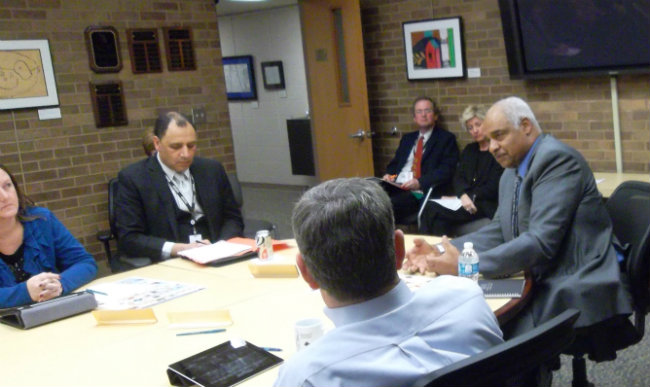
Muskegon Heights schools emergency financial manager Don Weatherspoon (right) talks to Muskegon Area Intermediate School Board members. Without the MAISD's help, Weatherspoon said “we would be probably still be fighting our way out of the mud."
Muskegon Heights students are heading back to class today to begin the second half of what’s been a very turbulent school year. This is the first in a four-part series looking at how things are going so far in Michigan’s first fully privatized public school district.

Old district “implodes” after years-long financial problems

The school board in Muskegon Heights battled a budget deficit for at least six years in a row. They gave up the fight a year ago and asked to state to just take over.
“The system that was in place imploded,” said Don Weatherspoon, the guy the state eventually sent in late April to be the emergency manager.
"Enrollment went down, costs went up, they borrowed more than they could pay back; you’re on a collision course with disaster and that’s what happened," Weatherspoon explained. Student enrollment is a big factor in how much money a school district receives from the state.
“Everything that you can think of basically broke down. Discipline, learning, record-keeping, financial accounting, etc,” Weatherspoon said.
By May, Weatherspoon discovered the district is more than $16 million dollars in debt; so much debt it couldn’t afford to open school in the fall.

Privatization “the only option” for viable 2012-2013 school year

The Michigan Department of Treasury and Governor Rick Snyder appointed Weatherspoon to avoid bankruptcy, so that was not an option. No other school district in the area wanted to merge with Muskegon Heights because then they’d have to take on the district’s massive debt.
So Weatherspoon did something different, something that’s not been done before in Michigan.
First, he laid off all the employees. The old emergency manager law allowed this.
From there it gets a little more complicated; but really, Weatherspoon had the power to create a new Muskegon Heights school district (the Muskegon Heights Public School Academy), authorized by the original one he’s been appointed to run (Muskegon Heights Public Schools) . The new school district is in the same area but it’s a totally separate, new, charter school district with its own school board that Weatherspoon appoints.
Most importantly, the new district has zero debt.

“Chaos” reins in rush to build a school system in less than 60 days

By early July the new school board hires Mosaica Education Incorporated, a charter school company, to run the schools. Class begin less than 60 days after the contracted was signed. The first month or so of class did not go smoothly. 
“At first when we got here, what was it  like? I don’t know, like, ‘crazy’ yeah it was crazy…” a group of high school students told me.
“It was just mayhem,” one former elementary teacher said.
“It was confusing. It was chaotic,” two other students chimed in. "A hot mess," another one said.
“Very chaotic. And chaos seems to be the word of choice to describe, not only that day, but all the other days,” another former teacher, Susan Strobel said. And she was right; nearly every person I interviewed uttered “chaos” or some form of the word to describe those 60 days before class started and up to the first 60 days or so once school started.
The high school principal quit before training was over. High school students didn’t get their class schedules for weeks and when they did, many had missing classes or the wrong classes.
Local clothing stores ran out of school uniforms because they didn’t have enough time to stock them (or weren’t informed at all the district was requiring uniforms). Cleaning and school supplies arrived late.
The school buildings were not up to state building codes for safety. The company had to invest more than $400,000 in building improvements to attain a "temporary occupancy" permit from the state. It lasts through March.
Daryl Todd says he was “very frustrated" during that time. He's a MHPS graduate who's optimistic that good opportunities can sprout from such challenges.


Credit Lindsey Smith / Michigan Radio
Arthur Scott, Carmella Ealom, Darryl Todd (left to right) were appointed by MHPS emergency manager Don Weatherspoon to make up a new school district; the Muskegon Height Public School Academy.
He’s one of three members on the new school board. When I talked to Todd just a few weeks ago he hesitated to say the chaos was over yet.
“I don’t necessarily feel that there’s a calm right now," he said with a chuckle. "Because I know that there are so many things that are happening that need to come together so that we can have this be a successful year,” Todd said. However, he does feel things are beginning to show some improvement.
As a decent example of some of the chaos, near the end of our chat at one of the district’s elementary schools, the woman from the front desk comes over the loud speaker. She announces “we are very short-staffed right now and zero people who are able to go into the lunch room.”
Teachers are instructed to feed their students in their classrooms or accompany them to the cafeteria.
“Wow…interesting” Todd says, closing his eyes as we pause to listen to the voice apologize for the inconvenience and promises to teachers to make up for the lost prep time.
“We will make it up to you; I promise, promise, promise,” the voice on the loudspeaker says.
Keeping teachers under such chaotic conditions is hard. More than one in four have quit so far this year.
I couldn’t get any current teachers to agree to a recorded interview.
Mary Valentine, one of the district’s most vocal critics, was not surprised.
“Teachers who are working over there are willing to say there are a lot of problems and there’s a lot of morale problems but they won’t say it out loud and they don’t want you to use their names because they are afraid of losing their jobs,” Valentine said. We’ll hear more from her later in this series.
And while those teachers are returning to work today, I did find some teachers who quit already and were willing to share their experiences. We’ll hear from them tomorrow.

Tuesday, January 1, 2013

NO MORE!

n response to Katie Osgood’s post, “A Message to Reformers,” Maureen Reedy wrote the following:
 
“Katie, Diane and Friends,

I am loving your article Katie, it is right on in every way.

No more! No MORE!!! NO MORE!!!!

I have contacted Ed Schultz, a production company in California, Michelle Alexander, author of The New Jim Crow who teaches at Ohio State, state senator and superintendents in Michigan, I have a panel ready to go with the media when we get someone to pick up the ball and run with it.

I have been in touch with Parents Across America about a project based on “Hands Across America,” where, state by state, we join together, simultaneously, on the same weekend afternoon, and celebrate public education and present the cold, hard facts of privatization to the public, across America… remember “This land is your land, this land is our land?”

I have been relentless since running for state rep in Ohio as former Ohio Teacher of the Year and being kept out of the Statehouse by a malicious 1.5 million dollar ad campaign the last 2 weeks of the election of which Michelle Rhee was a player. I am determined to join others and take action from the Outside/ In where ever, whenever and however we can.

As a 29-year veteran educator and supporter/supervisor/facilitator for over 250 IEP/IAT meetings in my elementary school each year, you have got it right!!!

These are perilous times for our kids who are fragile, vulnerable and at risk. Taking the experts out of the equation and ping-ponging children across town in the name of for-profit avarice and greed is destroying our children and their crucial connection to community.
We ALL have momentum and the power to get moving on CIVIL / HUMAN rights issue of our time, namely, protecting our children and preserving public education.

It is time to take action from the Outside/ In.
Keep contacting people in a position to bring Katie’s facts to light, keep going with reaching your contacts, newspaper columnists, talk show hosts, etc.


Keep moving with your words, your expertise, your stories, your ACTIONS.

Keep doing what you can to save our children and public education.
Thank you Katie, thank you Diane, thank you to all friends who are fighting for our precious children, the real victims of corporate reform.

Maureen Reedy
Parent/29 year Public School Teacher
Columbus, Ohio

Tuesday, December 4, 2012

STOP IT! STOP IT RIGHT NOW!


Below is a letter from Professor Charlene Beckmann, Ph.D.Professor of Mathematics and Mathematics Education, to Senator Goeff Hansen.  Below that is the initial correspondence that this letter is a response to.  Well worth the read.


Dear Mr. Hansen,  

We all agree that we want all children to have access to top-notch education; that is exactly what I am advocating. Forcing legislation through during the lame duck session is the opposite of the open and honest debate you mention below. Clearly, legislation regarding the future of children and their education is important. It is essential that time be taken for the open and honest debate to happen. To make an informed decision about the future of Michigan's children, the conversation must be extended to include educators input; these are the people who study education for a living (note that legislators are not known to be among this group!). Any educational decision that does not include educators at the table not only gives the appearance of impropriety, it is morally and ethically corrupt. The current decision appears to be entirely based on notions of finances and business rather than on the well-being of children.

The Emergency Manager bill that you supported has been forced on the Muskegon Heights community. As you know, the EM taking over Muskegon Heights Public Schools has not been successful; 20% of teachers hired by Mosaica have quit in the first few months. The bill you supported is having the effect of demoralizing Muskegon Heights teachers and families. If you truly have children's education at heart, I cannot imagine why you supported the Emergency Manager Bill. I also cannot imagine why you want to force another potentially damaging bill through the legislature. Not allowing citizens of a community to have a say in their lives is wrong. I can't imagine you would be willing to live under a dictatorship, but that is exactly what you're forcing on this community! The community needs help but this is not helping. The turn-over in teachers alone is wreaking havoc on the education of these students. An emergency manager has been in place in Detroit Public Schools for several years. What evidence do you have that the placement of the EM is helping the district? Where are the test scores showing improvement? 

I also wonder, how can you possibly believe that a corporation who is in business FOR-PROFIT can do a better job educating students than a non-profit public entity? If both groups receive the same money per student, who loses? The non-profit pours all of the money into education and the physical plant. For-profit corporations are clearly not spending everything they receive on education or there would be NO PROFIT! So who is losing? Currently, the losers are teachers who are paid poorly, required to work very long hours, and provided few benefits. The losers are also kids who are being subjected to substandard course materials (such as the Saxon math program chosen by Mosaica for Muskegon Heights children, likely because Saxon has a history of giving some books away to entice schools to buy their product). The bill you are proposing is not aimed at improving children's achievement. It is aimed at saving a few bucks... at the expense of the people who might very likely be in charge of your nursing home someday... Think about social security in a different way. When uneducated people are in charge, then what? Or are we already experiencing what cuts in education have done to Michigan's citizens (including its legislators)???

I hope you will think long and hard about the decisions you are helping to force on Michigan's children and take the time to make the right ones! Forcing a bill of such importance through during the Lame Duck session when Michigan's electorate demanded that you repeal the last version is certainly not what you were mandated to do as our representative!

Sincerely,

Charlene Beckmann, Ph.D.
Professor of Mathematics and Mathematics Education
Grand Valley State University
Allendale, MI 49401

Dear Senator Hansen:

I'm writing to ask you to oppose HB 6004/SB 1358 (on the Education
Achievement Authority) and HB 5923 (on new forms of charter schools).

I'm working with Muskegon Heights, one of the schools districts under an
emergency manager. Mosaica has basically destroyed the mathematics
education of the children in the district. They have chosen the worst math
program available and imposed it on the children of the district. This
corporation gets the same amount of money per child as do other public
schools, but they spend very little on kids and teachers. How is that
fair? They don't abide by the same rules. Of course they make a profit.
But while they're doing that... what about the students? What about the
teachers who are so dedicated to helping the children in this very low
income area? If you cannot see why public education is necessary and
should not be run by corporations, spend a week with the kids and teachers
at Muskegon Heights. You have no idea the damage your legislation is
imposing on this community! STOP IT!!! STOP IT RIGHT NOW!

I respectfully and strongly urge you to oppose HB 6004, 5923 and SB 1358.
I will be watching this misguided plan closely, and I look forward to your
response to my email. Thank you.

Sincerely,


Charlene E. Beckmann, Professor of Mathematics and Mathematics Education,
GVSU 231-780-3063

https://mail.google.com/mail/u/0/images/cleardot.gif
Dear Professor Beckmann,

Thank you for contacting me regarding SB 1358, HB 6004, and HB 5932; legislation that would codify the Education Achievement Authority into state law to benefit children in distressed schools across the state. I appreciate hearing from the educators in my district.

By way of background, the Education Achievement Authority is currently in place through an interlocal agreement between Detroit Public Schools and Eastern Michigan University.  Advocates of the legislation have stated that by putting this agreement into statute this will be another tool for local education officials to quickly and effectively improve perpetually failing schools.

Overall, I believe that our parents and children deserve to be in a setting that provides the best environment for maximum educational growth and opportunity.  We all should expect and demand excellence for our loved ones and not tolerate the status quo or mediocrity.

However, as I review the legislation, I do share legitimate concerns regarding the various powers and the proposed work of the Authority Board, the need for a statewide inventory and maintenance of unused school buildings and agreements to provide or receive various services, just to name a few.

We owe it to our parents and children to have a larger conversation on achieving educational excellence for Michigan's children.  Yet, it is within the details of the method of achieving this result that requires an open and honest debate to address these and any other concerns.

It's also important to note that the public unveiling of the Governor's Public Education Finance Project draft bill is a completely separate document and issue at this time.  This particular project will be one that is expected to be discussed in 2013.  I'm continuing to gather information on this issue and encourage future comments from constituents on this issue.

Sincerely,

Goeff Hansen
State Senator
34th District


________________________________________
From: beckmannc21@aol.com [beckmannc21@aol.com]
Sent: Thursday, November 29, 2012 1:01 PM
To: The Office of Senator Hansen
Subject: Don't take the Public out of Public Ed

Charlene Beckmann
3680 Dunecrest Drive
Muskegon, MI 49441-4421